
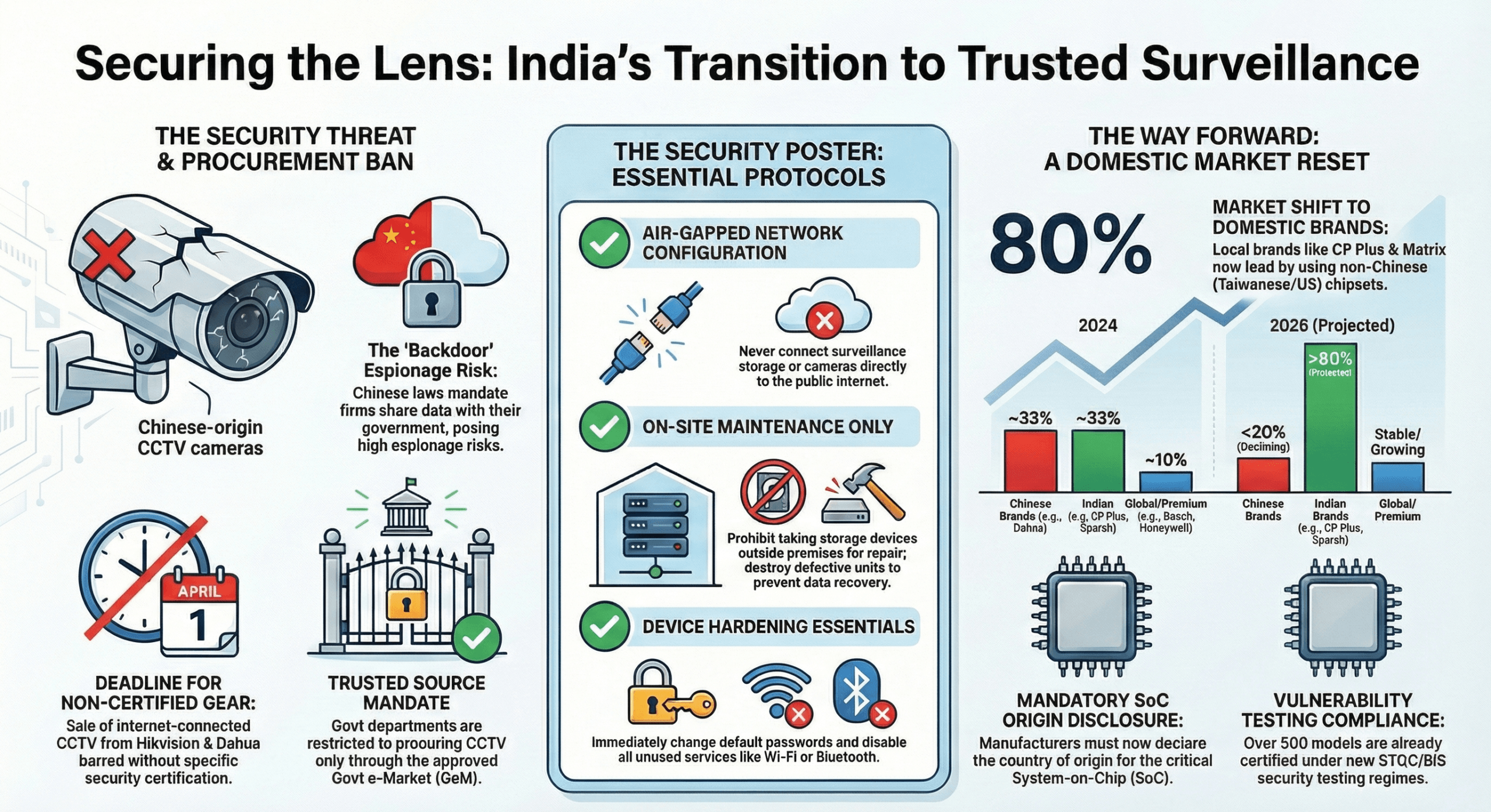
The Indian government has effectively banned the sale of internet-connected CCTV products from major Chinese manufacturers, primarily targeting industry giants like Hikvision and Dahua. This decisive action stems from severe national security concerns. Under China’s National Intelligence Law, all Chinese companies are legally obligated to cooperate with state intelligence services, handing over any collected data or discovered security vulnerabilities. Intelligence agencies have warned that these cameras could be exploited for espionage, data leakage, or even the sabotage of critical infrastructure by the Chinese Ministry of State Security.
To enforce this, the Ministry of Electronics and Information Technology (MeitY) introduced strict “Essential Requirements” (ERs). Manufacturers must now disclose the country of origin for critical hardware components (like the System-on-Chip) and pass rigorous testing at government-accredited labs to prove there are no hidden backdoors or unauthorized remote access vulnerabilities. Authorities are refusing to certify hardware that relies on Chinese-origin chipsets or firmware, effectively shutting these companies out of the market. Additionally, under an amendment to the General Financial Rules (Rule 144(xi)), the government has heavily restricted public procurement from any bordering countries, demanding rigorous political and security clearances.
Security Poster: Essential Best Practices for CCTV Networks:
For organizations and individuals navigating these risks, cybersecurity experts recommend implementing a strict defense-in-depth strategy. Here are the core guidelines to secure your surveillance infrastructure:
- Never Expose Cameras to the Public Internet: Place cameras behind firewalls and isolate them on dedicated, segmented networks (like a separate VLAN). Block all unnecessary outbound communications to prevent the device from communicating with foreign servers.
- Eliminate Default Credentials: Immediately change factory-default passwords, disable unused admin accounts, and utilize features like two-factor authentication or certificate-based access.
- Harden Device Configurations: Disable unused services (like Telnet or HTTP) and enforce encrypted connections (HTTPS or SSH) for all video feeds and management sessions.
- Maintain Firmware and Replace Obsolete Tech: Regularly apply firmware updates provided by manufacturers. If a camera is from a banned vendor or has reached its end-of-life and can no longer be patched, it must be prioritized for immediate replacement.
- Monitor Network Traffic: Deploy tools that continuously monitor camera traffic to establish a baseline of normal behavior. This helps detect anomalies, such as a camera suddenly transmitting data to an unknown IP address.
- Beware of “White Labeling”: Maintain an active inventory of all network devices. Be vigilant against “white-labeled” products—cameras sold under third-party or American brand names that still utilize banned Chinese hardware and software underneath.
The Way Forward
The surveillance market is currently undergoing a massive realignment toward a “trusted vendor” approach. The market void left by banned Chinese brands is rapidly being filled by domestic Indian manufacturers like CP Plus, Prama, Matrix, and Qubo. By shifting their supply chains to rely on Taiwanese and US chipsets alongside localized firmware, Indian players now control over 80% of the market.
While this shift enhances national security, it also carries economic implications. Moving away from cheaper Chinese components has caused a 15% to 20% jump in the bill of materials, leading to higher retail prices for mid- and high-end surveillance systems.
Moving forward, buyers must be meticulous about compliance. When purchasing new CCTV systems, consumers and businesses should specifically look for the Bureau of Indian Standards (BIS) Standard Mark and check the packaging for the mandatory declaration: “This CCTV camera complies with Essential Requirement(s) for Security”. Existing users of uncertified Chinese cameras should prepare for dwindling technical support and a complete lack of necessary software updates as these brands are forced to exit the Indian market.